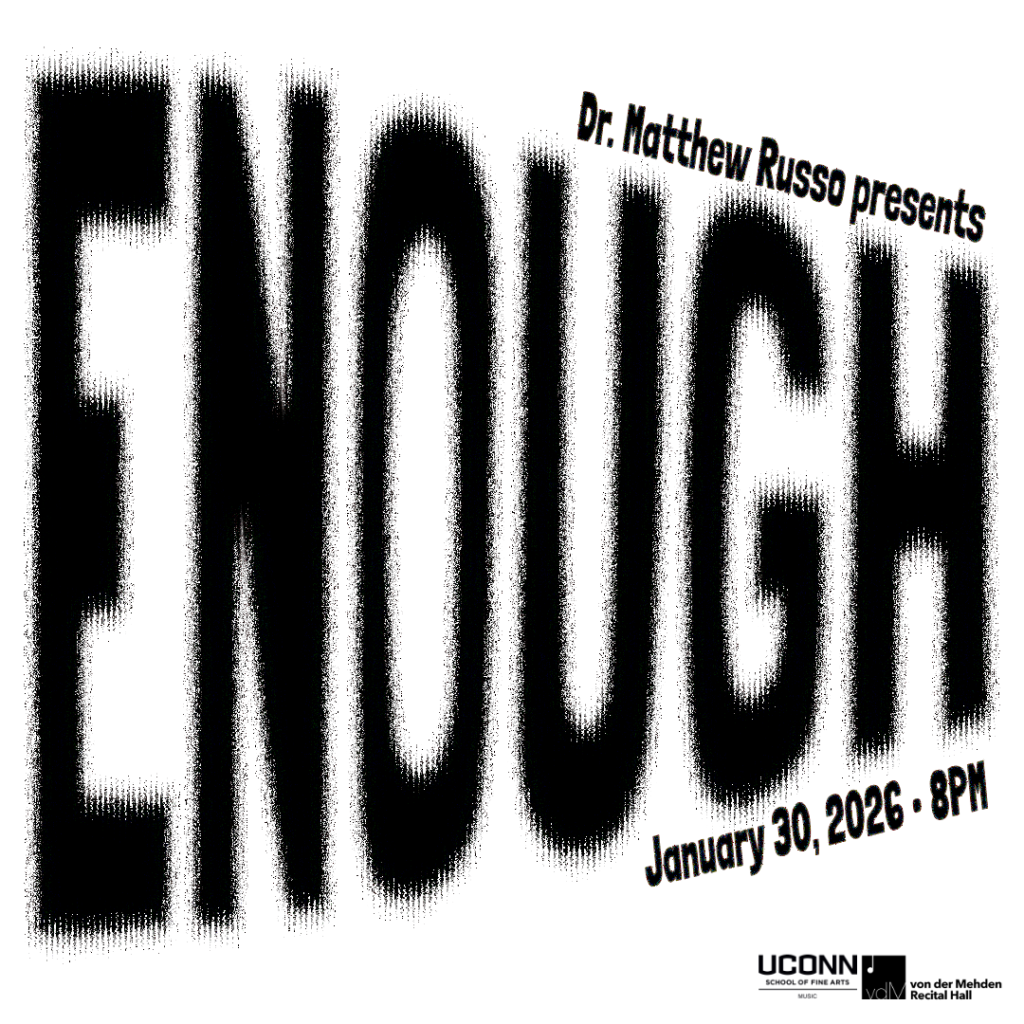
About the Program
I called this program Enough because it feels like today we’re constantly inundated with “too much” that it almost seems hopeless. But every time I confront my own feelings of giving in there’s a little glimmer of hope that shines through.
In designing this program, I found inspiration from two pieces of writing.
The first is the phrase that served as the inspiration for Cait Nishimura to write She Danced in the Rain.
“Life isn’t about waiting for the storm to pass; it’s about learning to dance in the rain.”
The other is from Lemm Sissay’s powerful Summer: My Mountain Top, especially these two closing lines:
I would see glistening hope in every single teardrop of pain
And I would hear the sound of music in all this falling rain
Program
Für Frankie (2020)
Michael Denis Ó Callaghan (BA ’16) (b. 1994)
In late 2020, my son’s beloved combination snow globe/music box stopped working. The cheap music box became overwound and then would no longer turn the drum and play the song. The song, Brother James’s Ayre, was a gift from his godmother and we played it every night before he went to bed since the day he received it. It being the height of the pandemic I became completely obsessed with trying to repair it. The music box itself was simple, removable, and inexpensive so I tried to find a supplier who sold a similar unit but I couldn’t find one with the same tune. I spent hours combing websites in different languages and listening to different sample recordings from the suppliers – I think any halfway decent therapist could easily deduce what was going on with this pursuit. I decided to buy an exact replica of the music box with the tune Für Elise and then would try to replace the small parts to repair it fully. Of course, I didn’t know a single thing about music boxes or how they worked.
My first attempt at a repair was to swap the drum, the notched cylinder in the music box that would pluck the pitched tines to create sound. I don’t know why I did this because obviously it wasn’t going to sound right. The result of that experiment is the audio you’re going to hear in für Frankie by Michael Denis Ò Callaghan. In replacing the drum in the donor unit, I was rewarded with the rhythm from Für Elise but the pitches from Brother James’s Ayre. It was a magical sound that I immediately posted it to social media. Michael heard the audio and commented (in 2020) asking if he could use the audio. Fast forward to 2022 when I re-shared the 2020 post and he realized that he hadn’t sent me his piece of music. Michael takes the audio and reshapes, twists, and interpolates it to create a beautiful soundscape perfect for the sonorous trombone to play in and above.
–Matthew Russo
She Danced in the Rain (2018)
Cait Nishimura (b. 1991)
“Life isn’t about waiting for the storm to pass; it’s about learning to dance in the rain.” This phrase reminds us to be adaptable, curious, openhearted, and brave; it inspires us to find the light in the darkness and hold onto hope during challenging times. This piece was written for my friend Caitlin Jodoin, someone who has always embodied this approach to life. My hope is that this music finds others who are learning to dance in the rain, too.
–Cait Nishimura
Concerto for Trombone “Sonorous” (2023)
Quinn Mason (b. 1996)
- Rhapsodic
- Mysterious
- Awaken
In 2020, Mark Davidson, the principal trombone of the Utah Symphony, commissioned me to compose my brass fanfare ‘Changes/Transitions’ to commemorate the protests of the summer of that year. Because it was so early in the pandemic, in person performances were suspended so Mr. Davidson took on the Herculean task of going to each brass player and percussionist individually to record their parts then enlisting an audio engineer to edit it all together. The video, a fantastic result even 4 years later, is still online available to view.
From there, a fruitful collaboration with the Utah Symphony started. Maestro Thierry Fischer ended up conducting the orchestra in the first live performances of the piece during the 2020-2021 season. Former associate conductor Conner Gray Covington and I have a mutual friend in common who introduced Conner to my music. Mr. Covington subsequently performed two pieces of mine with the orchestra – ‘A Joyous Trilogy’ and ‘Toast of the Town Overture’. Last summer, the orchestra toured my ‘Toast of the Town’ again, this time under current associate conductor Ben Manis. And this season, everything comes full circle with the Trombone Concerto ‘Sonorous’ written for the very person who started my association with this fantastic orchestra – Mark Davidson.
When Mr. Davidson and I began talking about this piece nearly 3 years ago (over BBQ in Texas), the first thing he mentioned was that he desired a new piece of music in which the trombone’s singing quality was emphasized. The more expressive side of the trombone is something I’ve always been interested in and explored before; in my composition ‘A Joyous Trilogy’, composed in 2019, the second movement is a slow ballad-like showpiece featuring a trombone solo, who stands up from their seat to play it. Inspired by this, and his suggestion of the nickname ‘Sonorous’, I set off to work.
The concerto is set in three movements. The first, Rhapsodic, is primarily focused on this singing quality that Mr. Davidson requested. In it, a pastoral theme is introduced by the trombone which is played in dialogue with the orchestra. The middle theme is slower and more of flowing, sustained and expressive. Throughout this movement one will hear the orchestra and trombone in conversation, sometimes lively and spirted, other times serious or innocent.
The second movement, Mysterious, is intended to show off the mystical side of the trombone’s tone. As a result, I employ the use of mutes to alter the trombone’s sound. In this middle of this movement, the solo trombone and 3 trombones in orchestra perform a 4-voice chorale to signify Mr. Davidson’s never-ending connection with his colleagues.
The finale, Awaken, finally gives us the virtuoso fire. Mr. Davidson is an artisan of the trombone and can literally do anything, so in this movement, the super cool technical side of the instrument’s capabilities is shown. A technique featured throughout this movement is double tonguing, in which the trombonist plays multiple fast notes in a row. In this sense, the trombonist is not really a trombone in this movement but more like a heavy metal guitarist.
–Quinn Mason
Basta (1982)
Folke Rabe (1935-2017)
I composed Basta in 1982 for Christian Lindberg who at the time was a student at the Royal College of Music in Stockholm, Sweden. The piece was commissioned by the College as a part of a project promoting the development of repertoire for solo trombone. Christian premiered Basta at a concert within the framework of the project.
In the early ’80’s I composed a series of virtuoso pieces for soloists on various instruments. Basta was the first of these. Here you can hear examples of extremely fast scale movements and chords that are produced when the player sings and plays simultaneously. The same techniques, very much further developed, are used in my trombone concerto All the lonely people written for Christian Lindberg in 1990 and recorded by him on the BIS CD label.
A frequently asked question is whether there is a story behind Basta. I never had any “story” or “program” in mind when I wrote Basta but it is true that the beginning and end set some kind of situation…
I got the idea that the player could be seen as a kind of messenger who hurries in and delivers his message and then – BASTA! – rushes away. (You know that “basta” in Italian means “ENOUGH!!!”.) But apart from that there is no further story like e.g. what is enough? or what is the message? or why this haste? That is up to everybody’s imagination. But I think that the music in itself, virtuoso as it is, at times carries a feeling of stress and haste, especially in the end where motives and fragments of motives are juggled around and phrases are not finished before the next one breaks in….
–Folke Rabe
Memory Home (2023)
Gala Flagello (b. 1994)
Memory Home (2023) was commissioned by trombonist Rich Williams and explores the relationship between memories and physical spaces. Rich asked that this work be written in memory of his first teacher, which prompted me to contemplate the way in which memories are formed at different stages of our lives. For many, a childhood home literally and figuratively houses formative remembrances, and, later in life, we might house our memories in different locations or within the walls of our own minds. Is it that to house a memory is to contain it? Should memories be contained? If we are to express them, have we unleashed them or are they still somehow at home with us? Many thanks to Rich for commissioning and premiering this work and for his support of new music for trombone.
–Gala Flagello
Vague Hope (Cold Rain) from NieR Automata (2017)
Keigo Hoashi (b. 1982)
NieR: Automata, a role-playing game released in 2017, is set in a future where humanity has long since fallen to time, and androids and machines battle across the remnants of a planet where nature has reclaimed the land, growing over cities and forests scarred by humanity’s wars. A sequel to 2010’s NieR, itself a sequel to 2003’s Drakengard, NieR: Automata takes place far in the future and is only loosely connected to the first game’s narrative (technically following the fifth ending of Drakengard).
Directed by Yoko Taro and developed by PlatinumGames, best known for Bayonetta, NieR: Automata was a massive success, selling over nine million copies to date. The game was widely praised for its battle mechanics, endearing cast of characters, and refinements to the series’ trademark use of multiple endings, totaling twenty-six possible endings. The game’s narrative addresses identity, and purpose, through the search for meaning in a world where the reasons for conflict have long been forgotten. It repeatedly asks whether that meaning comes from victory or survival, questioning how one’s sense of purpose shapes fulfillment in life. The relationships and experiences of the three main characters, androids 2B, 9S, and A2, gives the player distinct responses to loss, duty, and self-determination.
Vague Hope (Cold Rain) composed by Keigo Hoashi appears during the A and B endings of the game and reappears later during poignant scenes in the games second half. To avoid spoiling the narrative, it is enough to say that the piece accompanies a pivotal emotional scene that players likely won’t forget. The text is sung in NieR’s trademark Chaos Language, a constructed language that blends elements of several real languages and appears throughout the series’ music.
My Mountain Top (1998)
Andy Scott (b. 1966)
My Mountain Top is one of Andy Scott’s most popular and recorded works. Arrangements of the original saxophone quartet have been completed for solo saxophone, euphonium, alto flute & brass quartet and recorded by; Apollo Saxophone Quartet, Gerard McChrystal, David Thornton, Glyn Williams, Scherzo Brass, Paul Edmund-Davies and the composer.
Arranged by the composer for tuba virtuoso Les Neish, Les recorded ‘My Mountain Top’ on his CD entitled ‘Salt of the Earth’, (World of Brass, SFX 150) which was awarded CD of the Year by British Bandsman, Brassband World and 4BarsRest.
–Andy Scott
Performers
MATTHEW RUSSO
Trombonist Matthew Russo enjoys a dynamic career throughout the Northeast as an educator and performer. He has served on the faculty at The University of Connecticut since 2015 where he teaches applied trombone lessons, and leads the UConn Trombone Choir. Dr. Russo is principal trombonist of the Norwalk Symphony Orchestra and appears regularly with orchestras from New Haven, Hartford, Waterbury, Wallingford, Greater Bridgeport, and with Orchestra New England. Dr. Russo has been the resident trombonist at Goodspeed Musicals since 2017 and has played hundreds of shows over dozens of productions at Goodspeed. A frequent recitalist and advocate of new music, Dr. Russo strives to bring unknown works to new audiences through innovative programs and themes and has premiered more than a dozen solo works written expressly for him. His recording of Robert Carl’s Updraft for ten multitracked trombones was released on Neuma Records in April 2024. He is a proud S.E. Shires Artist. He lives in West Hartford, CT with his wife Katie, and their children Frankie and Maggie.
ELISABETH TOMCZYK
Pianist Elisabeth Tomczyk is a sought-after collaborator and chamber musician based in Vernon, CT. A native of Wisconsin, she began her study of piano at the age of three and was accompanying choirs and instruments by the age of nine. Elisabeth is an avid supporter of current music, premiering and recording many new works. She regularly performs with faculty, students and guest artists at The Hartt School, University of Connecticut and Wesleyan University and has done concerts all over the United States and Europe. She holds a Master of Music in piano performance from The Hartt School having studied with Dr. David Westfall and a Bachelor of Music in piano from Webster University having studied with Daniel Schene. When not performing, Ms. Tomczyk enjoys her time traveling, hiking and fishing with her husband. She is also an avid sewist and bag designer, running a small business on Etsy.